

Final Design
Hydrologic Analysis
Several methods were used to estimate and verify the expected flows through Cripple Creek since no USGS gaging station was applicable.
-
Regional regression equations (using StreamStats)
-
Bulletin 17C in HEC-SSP
-
Reference reaches with similar basin characteristics (found on the map to the right)
A climate change analysis was done using Flood Potential Portal, which found negligible change in expected flows.
All data was formatted into flow duration curves normalized by drainage area, found below.


Hydraulic Analysis
Survey data and the grain size distribution collected on site were used in HEC-RAS to estimate velocities along the eroding right bank and compare them to the determined permissible velocity of 6 ft/s.

The design solution was evaluated for its impact on bank velocities immediately post- construction and 5 years post-construction after vegetation has established.
Bank velocities were shown to have been reduced successfully to below the permissible velocity 5 years post-construction.
A 1% risk was determined for a storm to occur within 5 years that would be large enough to compromise the solution.


HEC-RAS model


Cross-Section Designs
Different areas along the channel received a unique combination of the following treatments to address their specific needs
-
Reduced bank slope
-
Floodplain benches
-
Live stakes
-
Brush layering
(Riparian seeding + coir fabric + live stakes)
-
Rootwad revetments


Planting Plan
Plant species and placement was designed to provide and support diversity in the ecosystem based on habitat and food function, foliage height , and seasonal blooming.
All plant species are native to Southwest Virginia to support local ecosystems.


Cost Analysis
The budget estimate showed that only about $300,000 of the $500,000 budget will be used during construction.
Costs go towards construction activities and materials with a 10% contingency for unexpected costs.

Construction Planset
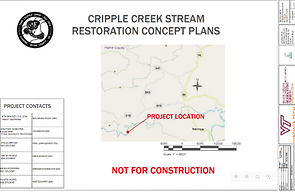


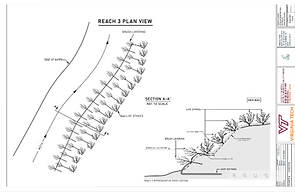


Civil3D was used to create a proposed construction planset for Trout Unlimited. These plans include the proposed grading and planting designs, along with a site narrative and an erosion and sediment control plans.
3D Printed Model

The surfaces used to create the construction planset in Civil3D were also used to design a 3D printed model.
Each segment represents the initial and proposed conditions of each reach.
The label of each segment corresponds to the reach number and vertical exaggeration.